Facebook Ads for Alcohol: Country Rules

Alcohol advertising on Facebook is possible in many markets, but approval depends on both Meta’s rules and the law where each person seeing the ad lives. If you’re researching country rules for facebook ads about alcohol, the safest approach is to treat every country—and sometimes every state or province—as a separate compliance market.
$ part ofFacebook Ad Account Problems: How to Fix Every Common IssueThe complete guide this article belongs toOpen guide →Key Takeaways
- Use country-level controls and age restrictions; never rely on a broad “worldwide” audience for alcohol campaigns.
- Check the legal drinking age, advertising code, licensing rules, required warnings, and delivery restrictions for every target market.
- Keep creative away from minors, intoxication, unsafe behavior, driving, sexual success, and health claims.
- Separate campaigns by regulatory market so one country’s rules don’t accidentally govern—or violate—another country’s requirements.
- Save proof of your license, product details, age-gating settings, disclaimers, and approval decisions before launch.
- Meta approval isn’t legal clearance; a compliant ad can still breach a state, provincial, national, or platform-specific rule.
Facebook Alcohol Ad Country Rules
Alcohol campaigns involve three layers: Meta’s advertising standards, national or regional law, and industry self-regulatory codes. The strictest applicable rule usually determines the ad you can run.
Meta may restrict alcohol advertising by age and location, and it can reject an ad if the landing page, targeting, or creative conflicts with local law. Review Meta’s alcohol advertising policy before building the campaign, then check the regulator or advertising code for each market.
A useful compliance file should identify:
- The product category, such as beer, wine, spirits, hard seltzer, liqueur, or alcohol-free substitute.
- The advertiser’s legal name, license number, and licensed business address.
- Every country, state, province, or territory in the intended audience.
- The legal drinking age and any permitted age for advertising exposure.
- Required health warnings, responsibility statements, or disclosures.
- The final ad text, image, video, landing page, and checkout path.
Don’t assume that a product marketed as “low alcohol,” “nonalcoholic,” or “alcohol-free” is automatically outside alcohol rules. Definitions vary, and a product containing a small amount of alcohol may remain regulated.
Meta’s Baseline Policy
Meta’s baseline is only the starting point. Alcohol ads generally need lawful content, suitable targeting, and responsible presentation. Ads must not be designed to attract children or use people who appear underage.
The following choices create avoidable risk:
- Cartoon characters, toy-like bottles, school settings, or language associated with young audiences.
- Audience interests that clearly include minors, even when the campaign’s declared minimum age is higher.
- Images of people drinking heavily, appearing drunk, vomiting, passing out, or losing control.
- Scenes involving driving, swimming, climbing, operating machinery, or other unsafe activities while drinking.
- Claims that alcohol improves health, athletic performance, intelligence, employment, popularity, or sexual ability.
- Promotions that encourage rapid consumption, drinking games, oversized servings, or “all you can drink” behavior.
- Landing pages that allow an underage user to buy, subscribe, enter a giveaway, or receive alcohol without meaningful age controls.
Age targeting isn’t a magic shield. A campaign can still be unsuitable if its imagery, copy, creator, placement, or audience signals appeal strongly to minors. Review the whole customer journey, including comments, instant forms, direct messages, and retargeting audiences.
Targeting settings
Set a minimum age that meets the strictest rule for the specific ad set. Then limit the geographic boundary to places where your license, delivery service, and advertising permission apply.
Avoid:
- “Worldwide” or “all countries” targeting.
- Radius targeting that crosses a national border.
- Lookalike audiences built from users whose age or location is unknown.
- Retargeting lists without documented age and consent controls.
- Automatic expansion that can broaden delivery into a less suitable audience.
If Meta’s available age controls don’t match a country’s requirements, don’t compensate by guessing. Pause that market and ask Meta support or local counsel for a documented solution.
United States Rules
The United States has no single alcohol advertising rule that answers every Facebook question. Federal requirements interact with state laws, platform standards, trade practice rules, and the advertiser’s license.
The legal drinking age is 21 nationwide, but advertising obligations can still vary by product and jurisdiction. The Alcohol and Tobacco Tax and Trade Bureau, or TTB, regulates federal labeling and advertising matters for beer, wine, and distilled spirits. State alcohol control agencies may impose additional restrictions on promotions, delivery, coupons, contests, influencer activity, and retailer advertising.
Federal considerations
Your ad should accurately identify the product and avoid misleading statements. Pay particular attention to:
- False or misleading health claims, including statements about weight loss, disease prevention, hydration, or improved performance.
- Implied therapeutic benefits from ingredients such as vitamins, botanicals, electrolytes, or CBD.
- Unclear sponsorship or influencer relationships.
- Promotions that hide material conditions, purchase limits, eligibility rules, or shipping restrictions.
- Creative that suggests drinking is necessary for professional advancement, romance, social acceptance, or personal transformation.
The product’s category matters. Rules and recordkeeping can differ for malt beverages, wine, and distilled spirits. A retailer, manufacturer, importer, wholesaler, and affiliate may also have different responsibilities.
State-by-state issues
State rules commonly affect promotions and sales, not just the ad image. Check whether the campaign involves:
- Discount codes or “buy one, get one” offers.
- Free alcohol, sampling, sweepstakes, or prize-based promotions.
- Direct-to-consumer shipping.
- Delivery by a third-party platform.
- Retailer-to-consumer advertising across state lines.
- On-premise events, tastings, or reservations.
- Influencer compensation or affiliate commissions.
A campaign can be acceptable in California but unsuitable in Utah, for example, because licensing structures and promotional restrictions differ. Build separate ad sets where states have materially different rules rather than forcing one disclaimer to cover all 50 states.
| U.S. campaign element | Main compliance question | Safer operating approach |
|---|---|---|
| Age gate | Is every exposed user at least 21? | Set 21+ targeting and review audience expansion |
| Delivery | Can the seller ship to the destination? | Exclude states and ZIP codes outside the license |
| Discount | Is the offer legal and clearly described? | Show limits, dates, exclusions, and responsible terms |
| Giveaway | Does the prize involve alcohol or purchase? | Obtain state-specific review before launch |
| Influencer post | Is the commercial relationship obvious? | Use clear sponsorship disclosure and approved language |
| Retail ad | Is the advertiser licensed for the promoted sale? | Match the ad account, landing page, and license holder |
Warning: “21+” in the caption doesn’t fix an ad that reaches minors through an unrestricted audience, a youth-oriented creative style, or automatic placement and expansion settings.
Canada Rules
Canada’s legal drinking age is generally 18 or 19, depending on the province or territory. Alberta, Manitoba, and Quebec use 18; most other provinces and territories use 19. That’s only the first check.
Alcohol advertising is shaped by federal standards, provincial liquor authorities, and local rules. A campaign may need different treatment in Quebec than in Ontario or British Columbia, particularly where language, retail control, promotion, and sponsorship are concerned.
Canadian alcohol creative should avoid:
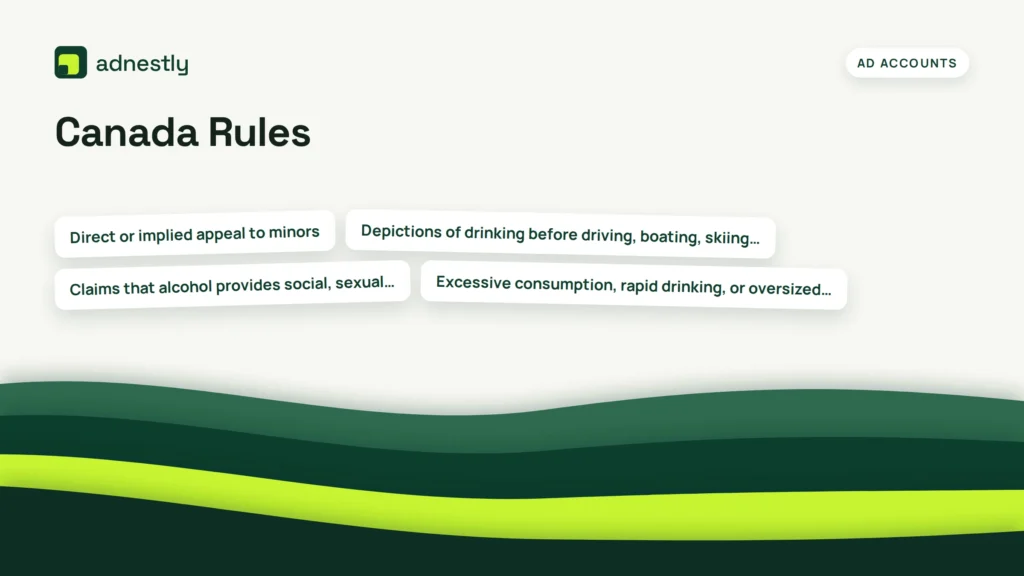
- Direct or implied appeal to minors.
- Depictions of drinking before driving, boating, skiing, swimming, or working.
- Claims that alcohol provides social, sexual, professional, or athletic success.
- Excessive consumption, rapid drinking, or oversized servings.
- Messages that portray abstaining as weak, boring, or socially inferior.
- Promotions that obscure pricing, eligibility, location, or responsible-use conditions.
Check the requirements of the relevant provincial liquor authority before advertising a retail offer. Also determine whether the advertiser is a manufacturer, provincial retailer, licensed restaurant, delivery service, or event organizer. Those roles can change what a promotion is allowed to say.
For a national campaign, use separate provincial ad sets when the product, price, retailer, delivery area, or legal drinking age differs. In Quebec, review French-language obligations and local advertising expectations instead of translating an English ad at the last minute.
United Kingdom Rules
In the United Kingdom, alcohol advertising must meet the applicable advertising code and other legal requirements. The usual legal purchase age is 18, but the ad still must not appeal particularly to people under 18.
The strongest UK risk areas are youth appeal, irresponsible drinking, and social or sexual claims. Avoid:
- Actors or influencers who appear under 25, unless their age and presentation have been carefully verified.
- School uniforms, youth culture references, games, toys, or settings strongly associated with children.
- Ads that make alcohol appear essential to confidence, popularity, romance, or sexual success.
- Suggestions that alcohol is a solution to anxiety, loneliness, stress, or personal failure.
- Immoderate consumption or scenes in which a person is clearly intoxicated.
- Promotions linked to speed drinking, drinking challenges, or pressure to keep up.
UK advertising rules can apply to paid social posts, creator content, branded content, and some promotional activity. A compliant-looking Facebook ad can still cause problems if the landing page uses a stronger or more reckless message.
UK creative checks
Before launch, ask whether a reasonable viewer could interpret the ad as encouraging antisocial behavior. Review the image, soundtrack, caption, comments, and call to action together.
Safer themes include:
- Product origin and production method.
- Flavor notes and serving suggestions.
- Food pairing.
- A clearly described event for adults.
- Responsible enjoyment in a calm, ordinary setting.
Avoid language such as “get smashed,” “drink until sunrise,” “no rules,” or “the party starts when you lose control.” Slang can create a compliance problem even when the image looks restrained.
European Union Rules
The European Union doesn’t have one fully uniform alcohol advertising code. EU-level audiovisual rules establish a baseline, while each member state can add stricter restrictions. National rules may govern television, video-sharing platforms, online display, sponsorship, product placement, influencer content, and health warnings differently.
A campaign covering the EU should therefore be divided into national markets, not treated as one legal audience. Pay attention to:
- The legal drinking age and purchase rules.
- Restrictions on targeting or appealing to minors.
- Health, nutrition, or performance claims.
- Sponsorship of sporting or cultural activities.
- Required responsibility statements.
- Local language and packaging disclosures.
- Rules for online sales and delivery.
France is a prominent example of a stricter national approach. Alcohol advertising may be limited largely to objective product information, with prominent health messaging and restrictions on lifestyle imagery under the Loi Évin framework. Don’t reuse a UK or U.S. lifestyle ad in France without specialist review.
Other European markets can also be highly restrictive. Norway, for example, has broad alcohol advertising prohibitions, while Sweden, Finland, Ireland, and others apply their own combinations of statutory rules and industry standards. A “Europe” ad set can accidentally deliver into a country where the format, product, or promotion isn’t permitted.
| Market approach | Typical risk | Campaign structure |
|---|---|---|
| France | Lifestyle and promotional claims may be restricted | Use factual product creative and French review |
| Germany | Youth protection, claims, and promotional rules need checking | Separate German copy and landing page |
| Ireland | Strong responsibility and youth-appeal concerns | Use local age controls and conservative creative |
| Norway | Broad alcohol advertising restrictions | Obtain legal confirmation before paid promotion |
| Sweden or Finland | National rules may be stricter than neighboring markets | Build separate country campaigns |
| Other EU countries | Rules differ by product and channel | Verify the local regulator and code |
Australia And New Zealand Rules
Australia and New Zealand both permit alcohol advertising, but responsible marketing expectations are significant. The relevant industry codes focus on adult audiences, moderation, and avoiding dangerous or socially harmful behavior.
In Australia, review the applicable alcohol advertising code and any state or territory requirements. In New Zealand, check the local advertising and promotion code, along with rules affecting sales, delivery, and promotions.
Avoid:
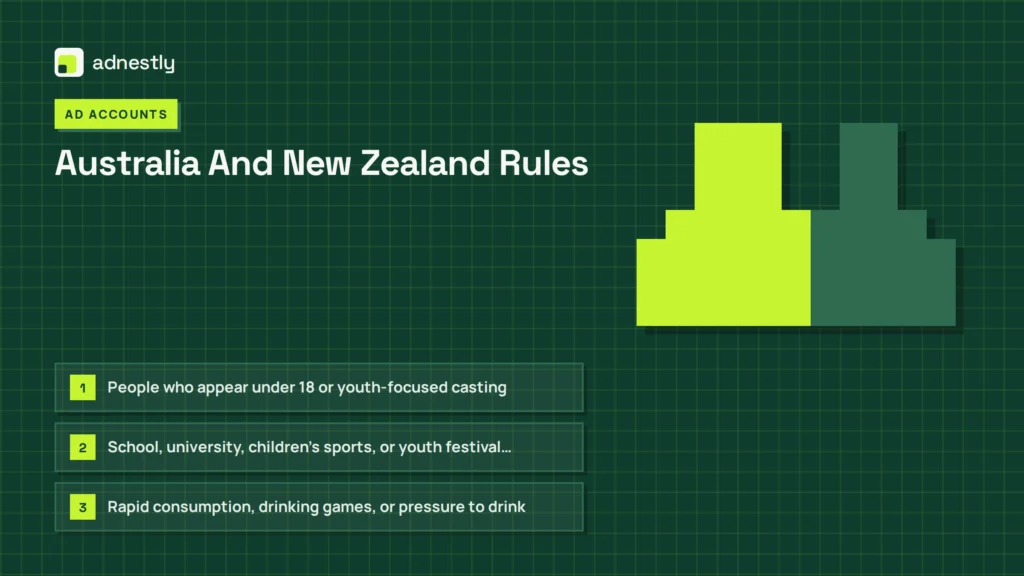
- People who appear under 18 or youth-focused casting.
- School, university, children’s sports, or youth festival settings.
- Rapid consumption, drinking games, or pressure to drink.
- Alcohol near driving, boating, swimming, extreme sports, or machinery.
- Claims that alcohol makes someone braver, more attractive, successful, or sexually appealing.
- Messages that celebrate aggression, disorder, or loss of control.
Use age-appropriate audience design, not just an age disclaimer. Exclude youth-oriented interests, review creator demographics, and ensure a promotion can’t be entered by an underage person.
For Australia and New Zealand, local spelling, responsible-use language, delivery conditions, and refund terms should match the landing page. A mismatch between the ad and checkout can be treated as misleading even when the product itself is legal.
Other Markets Need Local Review
Some markets allow alcohol advertising only within narrow boundaries, while others prohibit it outright or restrict it so heavily that ordinary Facebook promotion is impractical. High-risk markets include countries with religious alcohol prohibitions, state-controlled media systems, broad surrogate-advertising bans, or severe limits on online promotion.
Before targeting a new country, verify five items:
- Permission to advertise the product category.
- Whether alcohol may be sold or delivered legally.
- Whether paid social media is treated as advertising.
- Whether the creative needs local warnings or language.
- Whether Meta can technically enforce the required audience restriction.
Examples that deserve early legal review include Saudi Arabia, the United Arab Emirates, India, Singapore, Japan, South Africa, and countries in the Middle East or North Africa. The answer may differ for imported alcohol, alcohol-free products, restaurants, tourism businesses, and editorial content.
Don’t infer legality from competitor visibility. Competitors may be using an unlicensed account, a surrogate brand, a geo-fenced campaign, an old ad, or a product classification that doesn’t apply to yours.
Pro Tip: Keep a country decision log with the date checked, regulator or code consulted, reviewer, conclusion, and campaign version. Rules and platform enforcement change, so an old approval isn’t permanent protection.
Build A Compliant Campaign
A repeatable workflow is safer than reviewing each ad informally. Use one owner for legal checks and another person for creative quality control when possible.
1. Define the product
Record the alcohol percentage, category, pack size, manufacturer, importer, retailer, and intended sales channel. Identify whether the item is a brand ad, retail ad, event ad, restaurant ad, or affiliate promotion.
2. Map the audience
List every country, state, province, and territory. Confirm the drinking age and create exclusions for places where you can’t sell, ship, or legally promote the product.
3. Separate campaigns
Separate markets when they have different ages, languages, prices, disclaimers, delivery rules, or creative restrictions. Avoid one global ad set with automatic expansion.
4. Review the customer journey
Check the ad, profile, instant form, website, age gate, cart, checkout, email capture, confirmation page, and delivery process. Compliance failures often occur after the click.
5. Review claims
Remove unsupported health, wellness, performance, emotional, and sexual claims. Product descriptions should be factual and proportionate.
6. Preserve evidence
Save screenshots of targeting, placement, exclusions, landing pages, age gates, licenses, approvals, and final creative. Record who approved the campaign and when.
| Review stage | What to confirm | Evidence to save |
|---|---|---|
| Product | Category, ABV, seller, license | Product sheet and license |
| Audience | Age, country, exclusions | Ad-set settings screenshot |
| Creative | No youth appeal or irresponsible behavior | Final image, video, and copy |
| Landing page | Age gate, claims, pricing, delivery | Page capture and terms |
| Promotion | Eligibility, dates, limits, prize rules | Offer terms and approval |
| Launch | Placements, expansion, comments | Published settings and monitoring log |
7. Monitor after approval
Review comments and user-generated content. Hide or remove comments that encourage dangerous drinking, underage participation, driving after drinking, or drinking contests. If an influencer or affiliate changes the wording, pause the post and reapprove it.
What Gets Rejected?
Meta rejections can result from the ad itself, the audience, the landing page, the account history, or automated interpretation of the creative. Common triggers include unsafe behavior and unclear product positioning.
Typical rejection patterns include:
- A bottle shown beside car keys or in a moving vehicle.
- A person chugging from a bottle or holding multiple empty containers.
- “Tag a friend who needs a drink” or similar emotional-pressure copy.
- A giveaway that doesn’t clearly restrict entry to adults.
- A landing page with no age confirmation.
- An ad that targets a country where the product can’t legally be sold.
- A health claim about sleep, stress, metabolism, immunity, or hydration.
- A young-looking model, student setting, or animated character.
- Automatic translations that introduce prohibited claims.
- A “nonalcoholic” product that still looks like a direct alcohol promotion.
Don’t repeatedly submit the same rejected ad with tiny changes. Diagnose the trigger, revise the full experience, and use the platform’s review or appeal process when the campaign is genuinely compliant.
Troubleshoot Delivery And Compliance
A campaign may be approved but deliver poorly because the audience is too narrow, the bid is limited, or the account has a restricted history. It may also be technically eligible but commercially useless if the landing page blocks too many adults.
Use this troubleshooting sequence:
- Confirm the delivery geography in Ads Manager.
- Check whether automatic expansion changed the intended audience.
- Verify age settings at campaign and ad-set level.
- Inspect every placement, including audience network inventory.
- Test the landing page from each target country.
- Confirm the age gate works on mobile.
- Check whether the product can be shipped to each location.
- Review disapproved text, image, video, and destination separately.
- Replace unsupported claims rather than merely deleting one word.
- Keep a compliant backup creative for each market.
If a country produces repeated disapprovals while a neighboring country does not, assume the difference may be regulatory rather than technical. Pause that country, preserve the rejection notice, and request market-specific guidance.
Frequently Asked Questions
Can I run one alcohol ad worldwide?
Usually, that’s a poor compliance design. Drinking ages, warnings, licensing rules, advertising restrictions, and delivery permissions differ by country. Build separate campaigns or ad sets for markets with different requirements, and exclude places where you can’t legally advertise or sell.
What age should Facebook alcohol ads target?
Use the legal standard for the specific market, not a universal default. The United States generally requires 21+ audience targeting, while many other markets use 18 or 19. Confirm Meta’s current setting, local law, and any stricter product or channel rule before launch.
Can restaurants advertise cocktails on Facebook?
Often yes, but the restaurant still needs to follow local alcohol advertising, licensing, promotion, and delivery rules. Keep the creative adult-oriented and responsible, avoid intoxication or unsafe behavior, and ensure reservations, takeout, delivery, and discount terms are lawful in every targeted location.
Are nonalcoholic drinks exempt from alcohol rules?
Not automatically. A product’s alcohol content, branding, packaging, claims, and intended audience matter. A zero-proof drink may be treated differently from a low-alcohol product, but an ad can still create youth-appeal, health-claim, or surrogate-marketing concerns.
Why was my alcohol ad rejected after approval?
Reviews can occur at multiple stages, and Meta may later detect a targeting, landing-page, policy, or local-law issue. Check the full customer journey, audience expansion, comments, and product claims. Save the notice, revise the underlying risk, and appeal only when the complete campaign is compliant.
Do I need a lawyer for every country?
Not always, but local legal or regulatory review is sensible for new markets, promotions, influencers, delivery, spirits, and countries with strict restrictions. At minimum, document the applicable code, license position, age rule, creative limits, and reviewer for every country you target.
Conclusion
Start with a country matrix before creating the ad: list the product, license, legal age, permitted claim style, required warning, delivery area, and Meta audience setting. Have a qualified local reviewer confirm high-risk markets, then launch the smallest compliant test and monitor every destination separately.

Aaron Kelly writes about Facebook tools, account management, and business advertising. His content covers account security, Facebook Ad Accounts, Business Manager setup, Pixel and conversion tracking, Business Manager verification, and admin profile verification. He focuses on explaining technical processes and common account issues in practical terms, helping businesses and advertisers manage their Facebook assets more effectively and build a more secure, reliable advertising setup.
Checked against Meta’s own documentation. How we write and update guides