Facebook Ads for Health and Wellness: What Is Allowed

If you searched for what is allowed in facebook ads for health and wellness, the short answer is that Meta generally permits many wellness products and services, but it closely examines claims, targeting, imagery, and the destination page. Ads become risky when they imply a medical condition, promise guaranteed results, shame viewers, or promote restricted products without authorization.
$ part ofFacebook Ad Account Problems: How to Fix Every Common IssueThe complete guide this article belongs toOpen guide →Key Takeaways
- Avoid diagnosis language: Don’t say or imply that the viewer has diabetes, obesity, anxiety, chronic pain, or another health condition.
- Substantiate claims: Keep statements about weight loss, supplements, pain relief, sleep, or mental wellness accurate, specific, and supportable.
- Use neutral visuals: Product demonstrations, instructors, ingredients, and lifestyle scenes are safer than graphic body comparisons or exaggerated transformations.
- Review the whole funnel: Meta can evaluate the ad, video, form, website, checkout page, pricing, disclaimers, and follow-up experience.
- Target broadly: Use location, age where appropriate, interests, and first-party audiences without building audiences around sensitive health information.
- Appeal carefully: A rejection may be automated or caused by a small phrase, image, domain issue, or landing-page mismatch.
Meta’s Health Ad Standards
Meta doesn’t ban all health and wellness advertising. Its systems usually assess whether an ad contains a prohibited product, a misleading claim, sensitive personal-attribute language, or an unsafe experience. Approval isn’t permanent: an ad can be reviewed again after edits, increased delivery, user reports, or account changes.
Commonly permitted categories include:
- Yoga studios offering classes, workshops, or memberships.
- Personal trainers promoting general fitness coaching.
- Meditation apps describing relaxation, focus, or mindfulness features.
- Meal-planning services offering recipes and general nutrition education.
- Fitness equipment such as resistance bands, treadmills, and adjustable dumbbells.
- Beauty and self-care products that avoid medical treatment claims.
- Licensed clinics advertising consultations, provided the service and claims comply with local law.
- Over-the-counter products when the product, claims, and market-specific requirements are acceptable.
High-risk areas include prescription/recreational drugs, unsafe supplements, medical devices, cosmetic procedures, addiction services, and disease-treatment claims. Requirements vary by country, age group, product type, and destination.
Pro Tip: Treat Meta’s review as a combined compliance check, not a spelling test. Before publishing, read the ad aloud, inspect images, submit forms, and follow buttons on the landing page.
Which Claims Are Risky?
Health advertising becomes difficult when it moves from describing an offer to promising a personal outcome. “A strength program with three weekly workouts” describes a service. “This program will eliminate your back pain” makes a medical outcome claim that may require strong evidence and may not be appropriate for Meta’s advertising environment.
Safer claim patterns
Use language that describes the product, process, or experience without guaranteeing an individual result:
- “Build a consistent morning movement routine.”
- “Guided mobility sessions for different fitness levels.”
- “Recipes designed for simple weeknight preparation.”
- “A 10-minute breathing exercise for your daily routine.”
- “Designed to support comfortable sleep habits.”
- “Learn practical strength-training techniques.”
High-risk claim patterns
Avoid statements that guarantee, diagnose, shame, or present an outcome as universal:
- “Cure your arthritis naturally.”
- “You have stubborn belly fat.”
- “Lose 20 pounds without changing your diet.”
- “Reverse diabetes in two weeks.”
- “Never feel anxious again.”
- “Doctors hate this one trick.”
- “This detox flushes toxins from your body.”
- “Guaranteed results or your health will improve.”
A disclaimer alone doesn’t rescue a deceptive headline. The main message must be accurate before supporting qualifications are considered.
| Claim type | Risk level | Better direction |
|---|---|---|
| “Three beginner strength sessions each week” | Lower | Describe the schedule and audience neutrally |
| “Build strength with progressive workouts” | Moderate | Explain the method without guaranteeing results |
| “Get rid of back pain permanently” | High | Remove the cure promise and medical certainty |
| “Clinically proven to burn fat fast” | High | Use only if the exact evidence supports the exact claim |
| “Mindfulness exercises for a calmer routine” | Lower | Describe the practice, not a guaranteed mental-health outcome |
| “Stop panic attacks in five minutes” | Very high | Don’t promise an acute medical or psychiatric result |
Do Personal Attributes Matter?
Yes. Meta generally restricts ads that assert or imply a viewer’s personal attributes, including health conditions, medical history, disability, or other sensitive characteristics.
Compare these examples:
- Risky: “Are you struggling with obesity?”
- Safer: “Explore nutrition coaching for sustainable habits.”
- Risky: “Your arthritis is keeping you from moving.”
- Safer: “Gentle mobility sessions for people who want to move more comfortably.”
- Risky: “Do you suffer from depression?”
- Safer: “Learn evidence-informed mindfulness techniques.”
- Risky: “Tired of your embarrassing acne?”
- Safer: “A simple skincare routine for clearer-looking skin.”
The safer version doesn’t need to be vague.
Personal-attribute risks can appear in more than headlines. Check:
- Primary text and link descriptions.
- Video narration and on-screen captions.
- Image overlays and testimonials.
- Quiz questions and lead-form fields.
- Retargeting copy such as “Still dealing with insomnia?”
- Custom audience names and uploaded customer data.
- Website headlines shown after the click.
Don’t use ad personalization to reveal private health information. A retargeting ad shouldn’t tell someone that you know they visited a page about fertility, addiction recovery, cancer support, or another sensitive topic.
Which Offers Are Allowed?
The offer itself matters as much as the wording. A general fitness class is usually easier to advertise than a prescription medication. A nutrition course may be acceptable, while a supplement that claims to treat a disease can trigger review or enforcement.
| Offer or category | Typical ad position | Main compliance focus |
|---|---|---|
| Yoga, Pilates, or fitness classes | Usually permitted | Avoid guaranteed body or medical outcomes |
| Personal training | Usually permitted | Use realistic service descriptions and neutral imagery |
| Meditation or mindfulness app | Often permitted | Avoid promises to cure anxiety, depression, or trauma |
| Vitamins or supplements | Variable and higher risk | Check ingredients, claims, markets, and age restrictions |
| Weight-loss program | High scrutiny | Avoid guaranteed loss, rapid results, shame, and before-after framing |
| Medical clinic | Variable | Use qualified providers, accurate services, and local disclosures |
| Prescription medication | Restricted | Follow authorization, age, market, and platform requirements |
| Cosmetic procedure | High scrutiny | Avoid unrealistic results, shame, and misleading transformation claims |
| Medical device | Variable | Describe the approved use accurately; avoid unsupported outcomes |
| Addiction treatment | Restricted or specialized | Expect additional eligibility and certification requirements |
“Natural” doesn’t automatically mean safe or permitted.
Check each market’s rules. Keep:
- Ingredient lists and serving instructions.
- Clinical or technical substantiation.
- Provider licenses and certifications.
- Product registrations or required approvals.
- Refund, shipping, and subscription terms.
- Consent records for lead and customer data.
Warning: Never try to disguise a restricted product by calling it a “wellness formula,” “research compound,” or “natural solution.” Evasive wording can create both advertising and consumer-protection problems.
How Should You Target Audiences?
Health-related targeting requires restraint. Start with broad advertising signals, not diagnoses or intimate concerns.
Reasonable campaign inputs may include:
- Geographic service areas for a gym or clinic.
- Age restrictions required for the service or product.
- Broad interests such as running, yoga, cooking, or strength training.
- Website visitors where collection and use are lawful and properly disclosed.
- Customer lists collected with appropriate notice and consent.
- Lookalike or similar audiences built from eligible source data.
- Contextual creative matched to a general activity or lifestyle.
Avoid creating or naming audiences around:
- Cancer, infertility, addiction, eating disorders, or HIV.
- Depression, panic attacks, or a specific psychiatric diagnosis.
- Prescription use, medical procedures, or private treatment history.
- A person’s weight, disability, medical records, or insurance status.
- Sensitive quiz answers collected without clear permission.
- Lists purchased from brokers with unclear consent or provenance.
A broad audience can also improve the wording.
What Creative Usually Passes?
Creative should show what the customer receives, not exploit fear or insecurity.
Generally safer creative includes:
- Instructor demonstrations with ordinary, non-shocking movement.
- Product packaging shown clearly and accurately.
- Recipe preparation using recognizable ingredients.
- App screens that match the actual product.
- Calm lifestyle scenes showing a general routine.
- Educational diagrams that don’t exaggerate anatomy or disease.
- Customer testimonials that are truthful, authorized, and not presented as typical guarantees.
Avoid:
- Graphic medical images, wounds, needles, or bodily fluids.
- Close-ups of cellulite, acne, hair loss, or body areas designed to embarrass.
- Before-and-after images implying everyone will achieve the same result.
- A person touching or pinching a “problem area.”
- Fake news layouts, fake medical endorsements, or fabricated credentials.
- Countdown timers that reset, fake scarcity, or misleading “free” offers.
- Visuals that make a supplement appear to be prescription medicine.
| Creative element | Lower-risk example | Higher-risk example |
|---|---|---|
| Headline | “Build a practical movement routine” | “Fix your body in 14 days” |
| Image | Trainer demonstrating a squat | Enlarged image of a “before” stomach |
| Testimonial | “I enjoyed having a structured plan” | “This cured my chronic pain” |
| Video opening | “Here are three mobility drills” | “You’re doing this because your joints are damaged” |
| Call to action | “See the class schedule” | “Claim your guaranteed transformation” |
Use testimonials carefully. Don’t edit a medical professional’s statement into an endorsement they didn’t make, and don’t imply a professional relationship that doesn’t exist.
Do Landing Pages Pass Review?
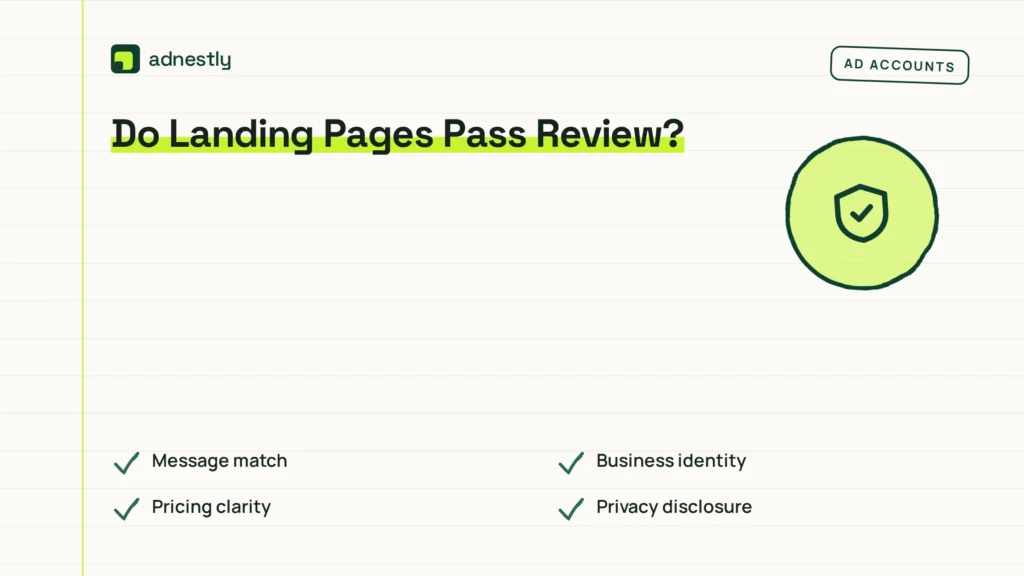
The landing page must deliver what the ad promises. If the ad says “free meal-planning guide,” the page should make that guide available without surprising charges or an unrelated sales funnel. If the ad promotes a consultation, the page should identify the provider, service, location, and relevant limitations.
- Message match: Headline, image, offer, and call to action align.
- Business identity: Company name, contact details, and support options are visible.
- Pricing clarity: Subscription renewals, shipping, taxes, and trial conversions are explained.
- Privacy disclosure: Data collection and marketing permissions are understandable.
- Health disclaimers: Relevant limitations are prominent, not hidden in a footer.
- Provider information: Licensed professionals are identified accurately.
- Checkout integrity: No prechecked add-ons, fake urgency, or surprise charges.
- Mobile usability: Forms, buttons, menus, and disclosures work on a phone.
Lead forms should request minimum information. For a fitness class, name, email, location, and session may be enough. Don’t ask for a diagnosis, medication list, or medical history without a lawful reason and secure process.
How Do You Build A Compliant Campaign?
Use a staged process before launch. Separate policy from creative review to prevent risky promises.
1. Define the offer
Write one sentence explaining what is being sold, who provides it, where it’s available, and what the customer receives. Remove medical outcomes unless necessary and supported.
2. List every claim
Copy every claim from the ad, video, landing page, testimonials, checkout, and follow-up emails into a document. Mark claims about:
- Weight or body composition.
- Disease prevention or treatment.
- Pain, sleep, mood, or energy.
- Speed, certainty, or permanence.
- Professional endorsements or scientific evidence.
- “Free,” “risk-free,” “guaranteed,” or “limited-time” pricing.
3. Replace risky wording
Change “cure,” “reverse,” “erase,” “melt,” and “guaranteed” into accurate descriptions of the service or product. Don’t repeat the risky promise elsewhere.
4. Inspect audience settings
Remove sensitive interests, custom audience labels, and unnecessary data fields. Confirm that age and location settings fit the offer and local law.
5. Test the destination
Submit the form, check the confirmation email, inspect subscription terms, and verify that the product shown is the product delivered. Check desktop and mobile views.
6. Document substantiation
Keep evidence for material claims, including approval dates.
| Review stage | Owner | Pass condition |
|---|---|---|
| Product and offer | Business owner | Product is lawful and accurately described |
| Claims | Compliance reviewer | Each material claim has support or is removed |
| Creative | Designer or marketer | No prohibited imagery, implication, or endorsement |
| Targeting | Media buyer | No sensitive audience construction or unnecessary data |
| Destination | Web or operations team | Pricing, privacy, forms, and content match the ad |
| Final approval | Account administrator | Version, evidence, and changes are recorded |
Pro Tip: Save a dated copy of the approved ad, landing page, audience settings, and supporting evidence. If a later edit causes rejection, you can identify what changed instead of guessing.
Why Was My Ad Rejected?
A rejection doesn’t always identify the exact offending phrase. Automated systems may classify an ad based on the combined text, image, video, destination, account history, and product category. Look for the most obvious issue first, then make one controlled change at a time.
| Rejection pattern | Likely cause | Practical fix |
|---|---|---|
| “Personal attributes” | Copy implies a diagnosis, symptom, or insecurity | Replace “you have” language with neutral service language |
| “Misleading claims” | Guaranteed, rapid, permanent, or unsupported result | Remove certainty and document the remaining claim |
| “Prohibited content” | Product or treatment is restricted | Check market rules and eligibility before resubmitting |
| Repeated disapproval | Landing page, domain, or account history | Audit the full funnel and request a review if appropriate |
| Ad approved, delivery limited | Audience, age, category, or quality concern | Broaden targeting and check restricted-category settings |
| Business rejected | Missing identity, billing, or verification information | Complete accurate business and payment details |
Don’t duplicate ads with tiny spelling changes to evade review. That can make the account look more suspicious. Instead:
- Screenshot the rejection notice and record the ad version.
- Compare the rejected version with the last approved version.
- Remove the strongest medical or personal implication.
- Check the destination page and checkout process.
- Request a manual review when the revised ad genuinely complies.
- Pause related variants until the underlying issue is understood.
If a business sells a restricted product, rewriting copy may not be enough.
Examples You Can Adapt
The following examples illustrate direction, not guaranteed approval. Context, product details, imagery, and destination content can change the outcome.
Fitness coaching
Risky: “Are you overweight and embarrassed by your body? Lose 15 pounds fast.”
Better: “Structured strength and nutrition coaching for adults building sustainable routines.”
Why it’s better: The revised version describes the service and intended goal without labeling the viewer, shaming the body, or promising a specific result.
Meditation app
Risky: “Stop your anxiety attacks tonight.”
Better: “Short guided breathing and mindfulness sessions for your daily routine.”
Why it’s better: The revised version avoids diagnosing the user and doesn’t promise an immediate psychiatric outcome.
Supplement
Risky: “This natural capsule reverses high blood sugar.”
Better: “View the ingredient list, directions, and product information.”
Why it’s better: It doesn’t present a supplement as a disease treatment or imply that “natural” means medically effective.
Physical therapy clinic
Risky: “Your knee injury is ruining your life. We will fix it permanently.”
Better: “Schedule an evaluation with our licensed physical therapy team.”
Frequently Asked Questions
Are health and wellness ads allowed on Facebook?
Yes, many are allowed, including fitness classes, yoga, meditation, general nutrition education, and some products. Category rules and claim wording still matter. Meta may restrict or reject an ad that diagnoses the viewer, promises a medical outcome, uses harmful imagery, promotes a restricted product, or leads to a misleading website.
Can I advertise weight-loss products?
Weight-loss advertising receives heightened scrutiny. Avoid rapid-loss promises, guaranteed results, shame-based language, body-focused embarrassment, and dramatic before-and-after imagery. Describe the program, education, or coaching process accurately, and make sure any numerical claim is supported and not presented as a typical or certain result.
Can I use health interests for targeting?
Don’t target people by sensitive medical conditions, diagnoses, treatment history, or private health concerns. Use broad interests such as cooking, running, yoga, or general fitness where available, along with lawful location, age, and eligible first-party audiences. Keep audience names and data fields neutral and minimal.
Why does Meta reject a harmless wellness ad?
The issue may be outside the visible headline. Meta can evaluate the image, spoken words, overlay text, landing page, lead form, pricing, domain, audience, and account history. Review the funnel from impression to checkout, then revise the specific risk rather than repeatedly duplicating the same ad.
Can a disclaimer make a health claim acceptable?
Usually not by itself. A small disclaimer can’t cure a headline that promises guaranteed weight loss, disease treatment, or permanent relief. The main message must be accurate, nonmisleading, and supportable. Use disclaimers to clarify limitations, eligibility, or professional advice—not to contradict an exaggerated promise.
Conclusion
A practical next step is to create one conservative ad variation, one matching landing page, and a short evidence file for every material claim. Check the audience settings and lead-form questions before submitting it, then use the review result to refine the campaign rather than escalating the promise.

Aaron Kelly writes about Facebook tools, account management, and business advertising. His content covers account security, Facebook Ad Accounts, Business Manager setup, Pixel and conversion tracking, Business Manager verification, and admin profile verification. He focuses on explaining technical processes and common account issues in practical terms, helping businesses and advertisers manage their Facebook assets more effectively and build a more secure, reliable advertising setup.
Checked against Meta’s own documentation. How we write and update guides