Facebook Ads Billing for Agencies: Credit Lines vs Client Cards


Client cards are best for most agencies; a Meta credit line wins with stable cash flow, strong client agreements, and access to monthly invoicing. For facebook ads billing for agencies, credit lines vs client cards means control versus convenience. Client cards clarify ownership but can fail when cards expire or banks block ad charges; credit lines reduce card issues but leave the agency with more payment and collection risk. Meta decides monthly-invoicing eligibility, so check Business account billing options.
$ part ofFacebook Ad Account Problems: How to Fix Every Common IssueThe complete guide this article belongs toOpen guide →Facebook ads billing for agencies credit lines and client cards compared
The three practical setups differ in who pays Meta, who controls the account, and who carries the risk when a charge fails.
| Method | How long | Effort | Cost | Best for |
|---|---|---|---|---|
| Meta monthly invoicing or credit line | Ongoing billing cycle | Medium | Low | Established agencies with predictable spend |
| Client card on the client’s ad account | Ongoing while the card works | Low | Low | Clear client ownership and smaller accounts |
| Agency card with client reimbursement | Ongoing while the agency funds spend | High | Medium | Trusted clients with strong payment terms |
| Manual or prepaid payment method | Until the balance runs out | Medium | Low | Tight spend control and limited campaigns |
A credit line can make billing smoother because the agency doesn’t need to manage a separate card for every client. The trade-off is exposure: if a client pays late, the agency may still owe Meta on the billing schedule.
Client cards usually create the cleanest audit trail. The client pays the advertising platform directly, while the agency charges only its management fee. However, the agency has less control when a card is declined, replaced, or limited by the client’s bank.
An agency-funded card gives you more control over campaign continuity. It also creates a collection problem, because your cash leaves before the client’s payment arrives. Manual or prepaid billing can limit overspending, but campaigns may stop when the available balance is exhausted. Availability, billing thresholds, and payment terms vary by account, country, currency, and Meta approval. Check Meta’s own Business billing screen for the options offered to your account.
Meta credit lines and monthly invoicing
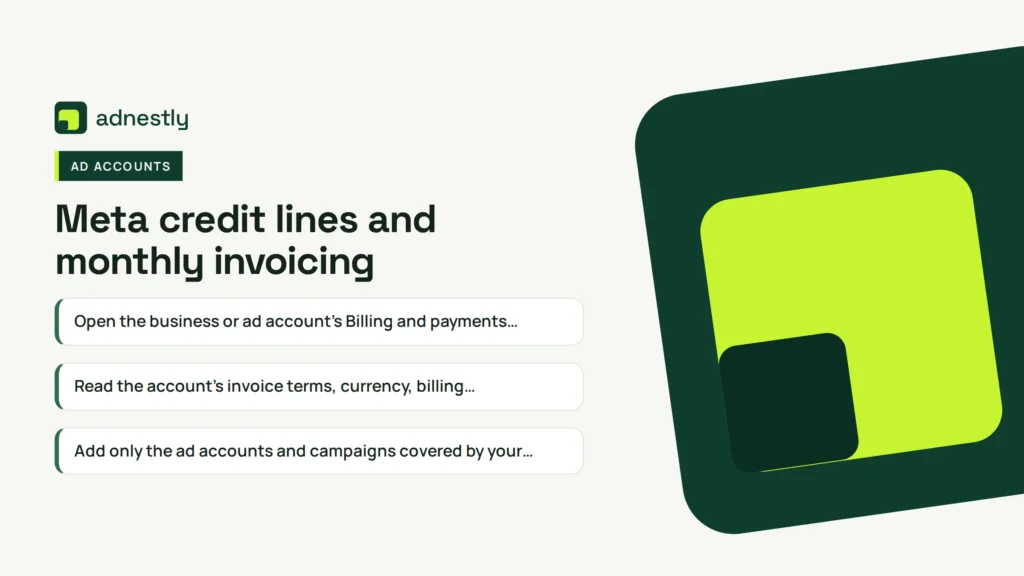
A Meta credit line, often described through monthly invoicing, lets an approved business receive ad charges and pay them under agreed billing terms. It isn’t a setting every agency can turn on. Meta decides eligibility and may ask for business, tax, credit, or payment information.
If your agency has access, use this process:
- Open the business or ad account’s Billing and payments area, then confirm whether monthly invoicing or a credit line appears as an available payment option.
- Read the account’s invoice terms, currency, billing contact, and payment instructions before moving any client spend onto it.
- Add only the ad accounts and campaigns covered by your written client agreement. Record each client’s budget, approval date, and billing responsibility.
- Reconcile Meta invoices against the account spend at least once each billing cycle. Keep the invoice, campaign report, and client charge together.
- If Meta changes eligibility, a payment term, or an account limit, pause new credit-funded work until you’ve confirmed the replacement payment method.
The method is good for agencies with repeat clients, predictable monthly spend, and a finance process that can match invoices to campaigns. It can also reduce card-expiry problems across several client accounts.
Its weakness is financial exposure. If a client disputes spend or pays late, your agency may need to fund the gap. Meta’s monthly invoicing guidance explains the platform’s account-level requirements and billing process.
This option isn’t for a new agency without cash reserves, written payment terms, or someone responsible for reconciliation. If the account involves credit approval, tax treatment, or a disputed debt, ask your accountant or finance adviser before changing the setup.
Client cards on client ad accounts
With a client card, the client pays Meta directly from an ad account the client owns. Your agency receives partner access to manage campaigns, but it shouldn’t need to hold the client’s payment details. This setup often gives the clearest separation between ad spend and your service fee.
Set it up in this order:
- Ask the client to confirm that the correct business, ad account, currency, and payment profile are being used before the card is added.
- Have an authorized client user add the card inside the client’s own billing area. Don’t ask for the full card number by email or store it in a shared document.
- Set campaign budgets and account spending controls according to the written approval. A daily budget isn’t the same as a fixed total campaign amount.
- Check delivery and billing status after campaigns start. Look for rejected payments, account spending limits, unusual spend, or a campaign that stopped delivering.
- At the end of the agreed period, send the client a report that separates media spend from your agency fee. Keep the client’s payment method in place only while the client wants it there.
This model is good for transparent ownership and easier reconciliation. It also keeps your agency’s cash available for payroll, tools, and other operating costs.
The weakness is dependence on the client’s card. A bank decline or expired card can stop delivery, and the agency may not be able to fix it without the client.
The biggest operational mistake is treating the card as the agency’s backup payment method. That can create unauthorized charges, unclear responsibility, and a dispute over who approved the spend. If the client can’t provide an authorized payment method, agree in writing whether campaigns will pause or move to agency funding.
Agency-funded cards for ad spend
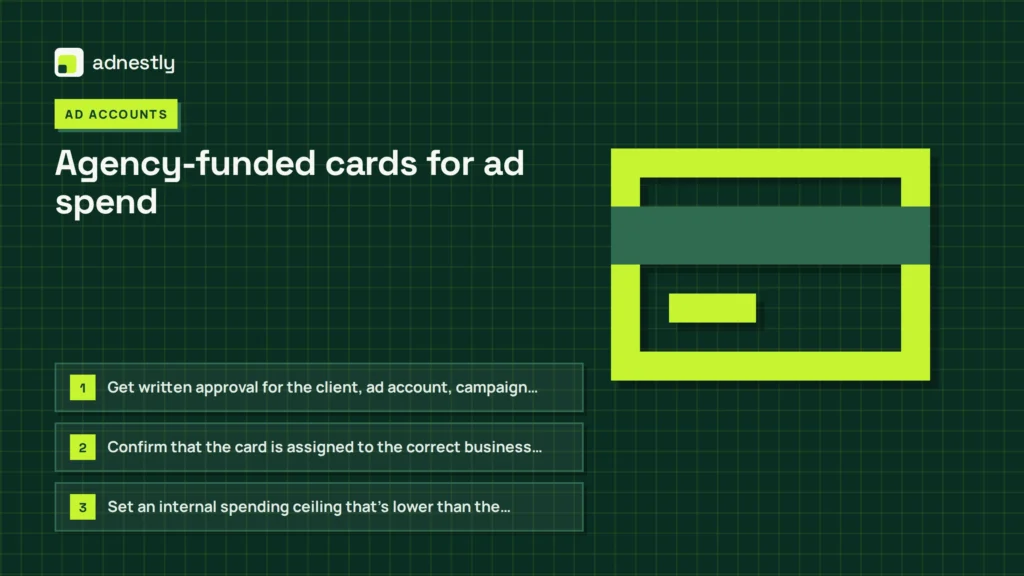
An agency-funded card means your business pays the platform first and then bills the client. It can keep campaigns running when a client doesn’t want to add a card, but it turns advertising spend into a short-term receivable for your agency.
Use a controlled process:
- Get written approval for the client, ad account, campaign purpose, budget, and start and end dates before funding anything.
- Confirm that the card is assigned to the correct business or ad account. Don’t mix several clients under one billing record unless your accounting system can separate every charge.
- Set an internal spending ceiling that’s lower than the maximum your card or credit facility allows. Your written client budget should be the working limit.
- Review spend daily during launch and at every agreed reporting point. Compare platform spend with your own card statement and client invoice.
- Invoice the client under the agreed payment terms, then stop new funded spend when the client reaches the approved limit or misses payment.
This method gives the agency operational control. It can help when a client’s bank is slow to approve advertising charges or when several campaigns need one managed billing workflow.
The cost is cash-flow risk and extra bookkeeping. A client can dispute the campaign, delay payment, or end the relationship while your card bill remains due.
This method isn’t for clients with unclear budgets, weak approval records, or a history of late payment. If the agency is using borrowed money or a credit facility, ask a qualified accountant about cash-flow treatment and the client contract before funding media spend.
A fourth option is manual or prepaid billing where Meta offers it. It can limit exposure, but it’s rarely worth the interruption risk for campaigns that need continuous delivery.
Which billing method should an agency use?
The right answer changes with the situation, not just the agency’s size. A card can be simple but fragile, while a credit line can be smooth but costly when clients pay slowly.
When you’re in a hurry
Choose a client card if the client already owns the ad account and has an authorized payment method ready. The setup is usually faster because you’re not waiting for credit approval or building an agency funding process.
Before launch, confirm the card works and the client has approved the campaign budget in writing. If the payment fails, pause the campaign and ask the client to resolve it rather than silently switching to an agency card.
When you’re doing this for the first time
Choose a client card because it limits the money your agency puts at risk. You’ll learn the reporting and reconciliation process without turning every client’s ad spend into an amount your business must collect.
This setup also makes your invoices easier to explain. Your client receives the media charge from Meta, while your agency invoice covers management, creative, strategy, or other agreed services.
When you want the best possible result
Choose a Meta credit line when your agency qualifies, has reliable finance controls, and can carry the client-payment risk. It can make multi-account operations cleaner and reduce repeated card failures.
The trade-off is less obvious than a card fee: control and continuity improve, but your agency becomes responsible for matching invoices and collecting client funds. For clients with uncertain budgets, a client card is safer even if it creates more payment interruptions.
If a client pays late, don’t keep funding new campaigns just to protect performance. Stop, document the unpaid amount, and restart only after the client agrees to the payment plan.
Billing rules for every ad account
Every method needs a clear owner, a written budget, and a way to match platform charges to the correct client. Meta’s available payment methods and account terms can vary by country, currency, business account, and eligibility, so the billing screen in your account is the final practical check.
Prepare the billing record before launch. Include the client name, business and ad account IDs, approved budget, campaign dates, currency, payment owner, agency fee, and the person who can approve changes. Don’t rely on a chat message that doesn’t show the full scope.
Check delivery and spend partway through the campaign, not only at month-end. Look for rejected payments, unexpected account spending, duplicated campaigns, wrong currency, and a campaign that’s spending after the approved end date.
At the end, save the invoice or payment record, platform spend report, client approval, and your agency invoice together. If the figures don’t match, pause new spend while you find the cause.
Ad billing can involve contracts, taxes, credit, and card-data handling. If you’re unsure about authority to charge, invoice treatment, or storing payment information, ask your accountant, lawyer, or payment provider rather than guessing.
The limit is that the result varies with Meta account eligibility, client payment behavior, currency, and bank controls; find your exact figure from the billing options and terms shown in that specific ad account.
Frequently asked questions
Can an agency use its own credit line for client ads?
Yes, an agency can fund client advertising when the account arrangement and client contract allow it. Record the approved budget, campaign dates, payment terms, and responsibility for disputed charges. Funding spend doesn’t automatically make the client liable; the contract should state whether media spend is prepaid, invoiced, or stopped when payment is late.
Why did Meta reject my agency credit line?
Meta may reject or withhold monthly invoicing when the business or ad account doesn’t meet current eligibility requirements. The reason may involve account history, business information, payment records, country, currency, or an internal review. Read the notice in Business settings and contact Meta support through the account; until resolved, use an approved payment method rather than repeatedly submitting requests.
How long does a Meta credit line approval take?
There’s no reliable public approval time that applies to every agency. The timing depends on Meta’s review, the business information requested, the account’s history, and the country or currency involved. Check the status in the billing area and answer requests from Meta promptly. Don’t launch a time-sensitive campaign on the assumption that approval will arrive soon. Keep an authorized client card or another approved method ready if the campaign can’t wait.
Is it safe to put a client’s card on an agency ad account?
No, not as a default arrangement. A client’s card on an agency-controlled account can complicate ownership, access, refunds, and disputed charges. A cleaner setup is usually a client-owned ad account with the agency granted needed access. If the arrangement differs, get written permission, limit access, and record every approved charge; never request or store full card details in email, chat, or a shared spreadsheet.
What happens if a client card is declined?
The campaign may stop delivering, or Meta may restrict billing until the payment issue is fixed. Check the billing notice and the client’s bank. Ask the authorized client user to update the payment method in the client’s billing area. Don’t add your agency card without written approval; if no replacement is available, pause the campaign and record the period.
Can clients see how much an agency spends on Facebook ads?
Yes, clients can see ad spend when they own the ad account or receive suitable reporting and account access. What they see depends on their permissions, the reports you provide, and the account structure. Keep media spend separate from your agency fee so the client can reconcile both amounts. A client should be able to identify the account, campaign period, currency, and amount charged without asking your team to explain every line.
Conclusion
Before your next campaign cycle, review each client’s payment setup, confirm who carries the risk, and put backup contacts and approval rules in writing. If your agency may qualify for monthly invoicing, ask Meta about eligibility and test the arrangement with one suitable account before changing how every client is billed.

Aaron Kelly writes about Facebook tools, account management, and business advertising. His content covers account security, Facebook Ad Accounts, Business Manager setup, Pixel and conversion tracking, Business Manager verification, and admin profile verification. He focuses on explaining technical processes and common account issues in practical terms, helping businesses and advertisers manage their Facebook assets more effectively and build a more secure, reliable advertising setup.
Checked against Meta’s own documentation. How we write and update guides